

Reef Recovery
Protecting the marine ecosystems of Papahānaumokuākea National Marine Sanctuary means more than preventing damage—it also means understanding how reefs respond and recover when impacts occur. Sanctuary scientists monitor coral reefs to assess damage, track recovery, and study what makes these ecosystems more resilient to change.
Reefs within Papahānaumokuākea can be affected by both natural and human-caused events. Marine debris, derelict vessels, or drifting buoys can physically damage corals. Extreme weather, such as hurricanes and tsunamis, can reshape islands and reefs in a matter of hours. Long periods of unusually warm water can also stress corals, leading to bleaching and in prolonged and more severe cases, mortality.
The following examples show how sanctuary scientists study these impacts and how life on the reef is beginning to recover after major disturbances.
Hurricane Walaka (2018)
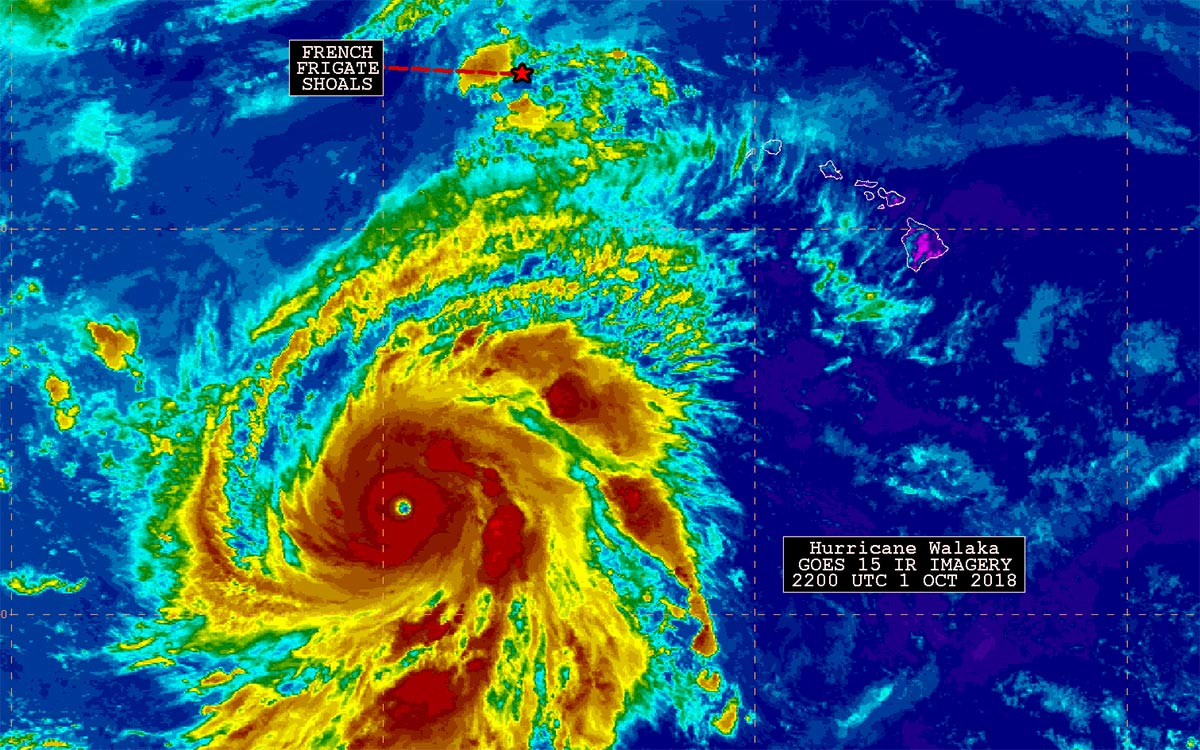
In October 2018, Hurricane Walaka ripped through Papahānaumokuākea National Marine Sanctuary as a Category 3 storm, directly passing over Lalo (French Frigate Shoals). Lalo is home to abundant wildlife and is one of the most significant coral reef systems in Papahānaumokuākea National Marine Sanctuary, with higher coral cover than many of the other atolls. Lalo is one of the most important wildlife sites in Papahānaumokuākea, providing nesting habitat for over 90% of Hawaiʻi’s threatened green sea turtles and serving as a key pupping site for endangered Hawaiian monk seals.
Hurricane Walaka had significant impacts on two of the small islands in Lalo—East and Tern. East Island was almost completely reclaimed by the ocean. Though a sliver of East remains, it was completely overwashed by the storm in October 2018. Some unhatched sea turtle nests at East Island were likely impacted by the storm; however, scientists estimated that there were no adult turtles utilizing the island for nesting or basking at the time the hurricane struck.
At Tern Island, storm surge deposited sand and debris across the island, swept away vegetation, caused erosion, and changed habitat conditions. Portions of the island were completely overwashed or inundated by the ocean. Plants such as beach heliotrope (Heliotropium foertherianum) were uprooted, burrows of nesting seabirds were flooded, and infrastructure left behind from the island’s days as a U.S. Navy airfield in World War II and a U.S. Coast Guard long-range navigation radio station were significantly damaged or destroyed. Unfortunately, some seabirds were killed and turtle nests were washed away by the storm. According to NOAA researchers, most of the monk seal pups of the year were weaned by the time the hurricane moved through the area—making them less vulnerable to the impacts from the storm.

This is not the first time islands have become inundated and lost in Lalo (French Frigate Shoals). Whale-Skate Islet was historically used as both a green sea turtle nesting and monk seal pupping area, and Trig Island was an important monk seal pupping area. As is common in sand-dominated ecosystems, Whale-Skate was lost to erosion during the 1990s, and Trig Island eroded earlier in 2018. Scientists have observed that when these events occur, animals often adapt by shifting their breeding sites to other locations.

Hurricane Walaka caused devastating damage to some of the vibrant coral reefs at Lalo, turning colorful, abundant underwater ecosystems into quiet expanses of rubble. By 2021 (three years after the hurricane), surveys documented recruitment by juvenile corals as well as the return of many juvenile and adult reef fishes to some of these sites. One particularly promising sign was the observation of herbivorous fishes such as manini, or convict tang (Acanthurus triostegus) and kole, or goldring surgeonfish (Ctenochaetus strigosus) at these reefs because these fishes graze on algae and keep the dead coral surfaces clean so that new, juvenile corals can take hold and grow.

Coral Bleaching
Coral reefs are highly sensitive to changes in ocean temperature. When water becomes too warm for too long, the relationship between corals and the tiny algae that live inside their tissues begins to break down. These algae provide most of the coral’s food and give reefs their vibrant colors. Under heat stress, corals expel the algae, turning white in a process called coral bleaching.
Bleached corals are still alive, but they are weak and more vulnerable to disease and starvation. If ocean temperatures return to normal soon enough, corals can recover—but if stressful conditions persist, many will die. Because corals build the very structure of the reef ecosystem, their loss has serious consequences for the countless species that depend on them.


Spanning 2014 to 2017, the third ever documented global coral bleaching event occurred affecting more coral reefs than any previous global bleaching event. The marine heat stress was the highest ever recorded, leading to mass bleaching, including on reefs that had never bleached before. Even the remote and protected reefs of Papahānaumokuākea were not spared.
Extreme warm water in 2014 led to mass coral bleaching within Papahānaumokuākea with reefs at Kapou (Lisianski Island) facing some of the most intense warm water and thus having the largest bleaching response. This resulted in a decrease in coral cover at long-term monitoring sites at Kapou from 40% to less than 15%. Just one year after the warm water event, dead coral and macroalgae cover had increased significantly, and there was a measurable loss of structural complexity in the impacted reef habitat. Return surveys in 2021 (seven years post bleaching) noted recovery of impacted corals as well as the appearance of young corals and crustose coralline algae, a hard algae that aids in coral recruitment and cementing reef structure.
